The CTC Spacecraft
Even if it has been a bad day, whenever I walk past the automotive paint section at Canadian Tire, that large rack of rattle-can aerosol paints, it always makes me smile. Many years ago, an organization I was with bought a case of twelve cans of Canadian Tire exhaust pipe enamel and sent it 22,000 miles away. If you are wide awake, you will realize something:
It is no longer on this planet.
I was called in to do two hours’ work on a proposal one winter Saturday at 9:00 AM – that miserable unpaid work that engineers have to endure in certain companies. But by the time I left at 11:00 AM, the story I had heard made the day worthwhile.
Several years before, we had been working on the Communications Technology Satellite, CTS, later renamed Hermes when it was launched on 27 Jan 76. I was on that program for three and a half years and I will definitely miss some aspects of it. The craftsmanship was one: our component quality engineer once showed my a circuit board and asked what I thought of it. I thought the solder joints had too little solder on them. He said, "Look at it through this eye loupe and see what you think." The solder fillets went halfway up the leads of the gullwing circuit leads. He continued, "You will never see a better soldering job than that." That was in 1976 and what he said was true - I have never seen craftsmanship like that again (or I should say craftswomanship) - the three women qualified for this job were like gods in the industry. While I was working on that proposal, I heard the real truth about how some other things were put together.
CTS was the first synchronous communications satellite with 200 watts output, so it could be received with an 8-foot diameter antenna. Modern satellite TV users have a 20” dish, but before CTS, you needed a 30-foot diameter radio telescope antenna – not the thing for consumers. CTS was designed to broadcast into communities in the far north where the receiving antenna could be hauled up on the back of a pickup truck.
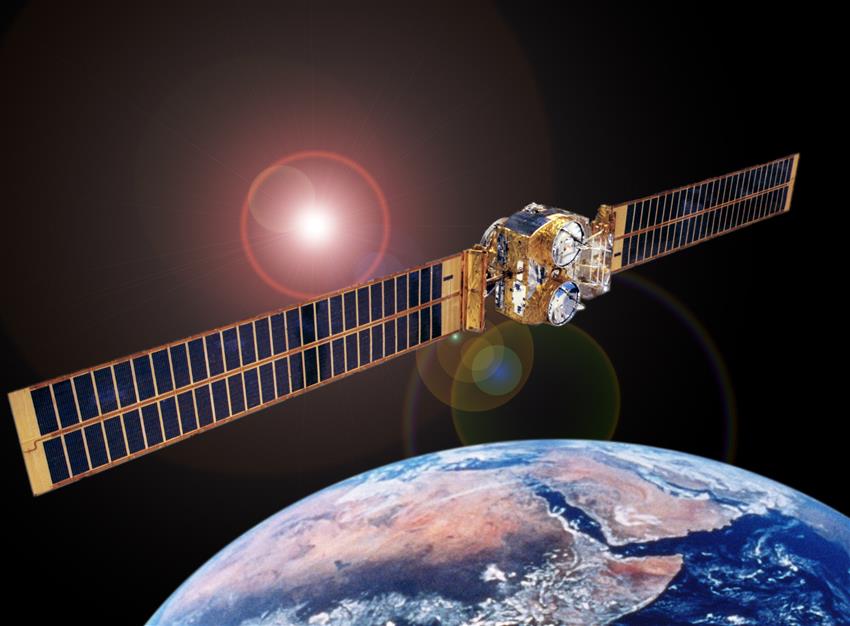
It was parked at 119 degrees west at synchronous altitude. To get there, it was launched on a Thor-Delta rocket with the Thor stage taking it to a low orbit of 120 miles and the Delta stage sending it into an elliptical orbit between 120 miles and the synchronous altitude of 22,236 miles. At the apogee, a solid-fuel rocket on the satellite itself burned for 28 seconds to circularize the orbit and bring the speed up to the synchronous speed of 6877.8 mph. Starting at a low orbit speed of 17,000 mph, the speed at the apogee is 3777 mph and for a 28-second burn, the acceleration is 110.74 miles per hour per second.
This was getting pretty close to the limit for the Thor-Delta. It can lift 1550 pounds into synchronous orbit and the satellite was slightly over 1500 pounds. The rocket on board the satellite was the most beautiful piece of spun stainless steel I have ever seen. It had a large combustion chamber about 4’ diameter narrowing down to a convergent-divergent nozzle and the whole piece of metal stood about 4’ high. It was 0.100” thick and this had raised a concern: toward the end of the burn that the nozzle would distort due to the heat and the satellite would not be able to reach synchronous speed. The rocket engine in the satellite was 723 pounds of which 692 pounds was propellant.
Someone suggested the simple idea that painting the outside surface of the nozzle with a flat black paint would enable it to radiate enough heat to retain its shape, so we contacted a supplier of space-qualified paint. Now it should be noted that satellites are trailing-edge technology. Nothing new ever goes into a spacecraft without an arduous testing process. Everything has to have an established reliability and preferably years of use before it can be put on a spacecraft. Every part, chemical or process has to be qualified by being subjected to rigourous qualification, or “qual” testing and until the entire suite of tests was over, it was never a slam dunk; parts could pass or fail qual. A few companies specialize in space-qualified parts but normal military testing (as done back in the 1970’s) was usually sufficient if the highest grades of components were used. (Nowadays, most satellites are built with commercial parts – but it was unthinkable then to risk a $60 million launch on parts with no history.) Anytime you wanted to add anything to the list of qualified items, you had to fill out a NONSPAR – a non-standard parts approval request and NASA would pass judgment on it. That was an arcane process that kept us on tenterhooks until it was complete.
We called up one supplier of space-qualified paint and his reply was, “Sure, we can give you immediate delivery. How many tank cars do you want and where is your railway siding?”
So we found a polite way to tell him no and called another supplier, who said, “Pints and quarts, sure, no problem. Fifteen months delivery.” This meant they had not qualified or even formulated the paint yet and there was a definite possibility that the paint would fail qual and leave us with nothing.
So one of our engineers came up with an obvious idea – what about automotive exhaust pipe enamel? We went to the nearby Canadian Tire store at Dufferin and Castlefield in Toronto and bought a case of 12 cans (which were $2.67 a can at the time). Canadian Tire Corporation is a unique company that has stores the size of a Home Depot that sells everything for cars, gardens, sporting goods and a lot of other indispensable stuff. We did not use the spray nozzle on the can – that would be too ghetto for any spacecraft – we had a very good De Vilbiss spray system, similar to what would be used for refinishing a car. We established that the paint had to be really roasted onto the metal at high temperature or it would not adhere. But once it was baked on, the adhesion was great. It would not flake or chip when tested for scratch resistance or discolouration under salt spray, the bane of anything stored near the ocean at Cape Kennedy.
Canadian Tire exhaust pipe enamel was qualified and flown on the CTS spacecraft. But before that, we had the problem of writing up the NONSPAR. We used the stock number which at the time was three numbers followed by a dash and three more numbers and listed it as “Paint, CTC Corporation” in the description and we buried it among other chemicals we were getting approved. NASA didn’t ask any questions. We certainly didn’t volunteer any information. According to the rules, only the paint from that particular case was qualified – approval is granted only for a certain manufacturer and run and there was no way to determine if any other paint was the same formulation or even came from the same company, since it is a private-label brand.
But in a world where product quality is a sore point for buyers of many items, isn’t it nice to know that you can purchase space quality products without even knowing it?
You will notice a couple of problems in the picture above:
1. The sun is behind the panels containing the solar arrays. Each panel is about 21 feet long and 6 feet high and there is a total of about 30,000 square inches of 1-inch square solar cells.
2. The spacecraft is shown over east Africa and it was never at synchronous altitude with the solar arrays extended at that longitude.


